LINDA HOFFMAN
The Mystery of Swallow

Sky above the Medicine Wheel at Old Frog Pond Farm, Night Photo: Robert Hesse
While in our individual quarantines we hear of mysteries revealed across the globe: In India, people can see the glow of the high Himalayas, fish are swimming again in the dank Venice canals, and above in the night sky, the stars in the milky way glow more brightly. Closer to home, I study tree swallows.
I’ve been watching an iridescent pair who have taken up residence outside my studio window. They perch on the top of a pine nesting box, one of a dozen my husband, Blase, built from scraps in his woodshop. I have yet to see either bird enter the box to lay eggs. Swallows, like most song birds, don’t lay all their clutch at once. The effort is too much; they lay only one egg a day. During this time of egg laying, the parents don’t immediately start incubating, but wait until the clutch is complete. Of course, I thought, how does she know when that last egg is laid? Maybe the way an artist knows when a painting is finished. It’s intuitive, there’s a satisfaction, a completeness. There’s a whisper, it’s done, it’s out of your hands. Release it, and trust.
This swallow pair must be waiting for the last of the eggs to be laid before they start nesting. They sit throughout the day, though occasionally one will fly, leaving the other alone. Rarely, do they both leave.
I have resisted peeking inside the box to see the eggs, I can only assume the eggs are accumulating. Once incubation begins, the parents will take turns sitting on the eggs for a week. Once born, the babies will remain in the nest for 18 to 23 days. Then, they must develop into expert flyers. For their migration from North America to South America will begin in the fall and will travel 200 miles a day at speeds from 17 to 22 miles per hour. However, storms, exhaustion, and starvation are challenges they will face, and it is estimated that only half will survive the journey.
To my surprise, both swallows suddenly take off. I watch for their return when a bluebird lands on their box, perky, though a little uncertain, making me think it is perhaps its first spring to find a partner and mate. The swallows immediately return, flustered at the sight of this interloper. What to do? Cautiously they fly toward the bluebird, wings shaking, approaching, but not getting too close. I think, why aren’t they dive bombing it? They need to protect their nest. The swallows dare to come a little closer, but the bluebird just twitches. The swallows fly out and back, and out and back, but never touch the bluebird. They don’t seem to be aggressive by nature, but they know they have to do something. Meanwhile, the bluebird doesn’t seem to realize it has landed on a box that belongs to others, or it is simply feigning innocence.
I watch more of their wing wagging, and think, this couple is completely ineffective, ridiculously so. Then, amidst more flutters of feathers, the bluebird departs. The swallow couple land on the top of the box, nudge close to each other, feathers touching, sharing the experience they have survived together. Whew! That was difficult! We best just sit here for a while.
Such mysteries of nature belong to us for we belong to nature; we are part of it. How could we be other? We’re made of the same molecules of water, air, and earth’s minerals. When I become demoralized by the problems on the planet, the greed I witness, the suffering brought on by this new pandemic, I remember that I am this earth, not separate from it. I am this morning’s melancholic rain making circles on the pond. I am the swallows anxious flutterings. Argentina may be 10,000 miles away, but the swallows will connect us. They connect me to you. Isn’t that amazing?

First Swallow, LH

Aerial Bruststrokes
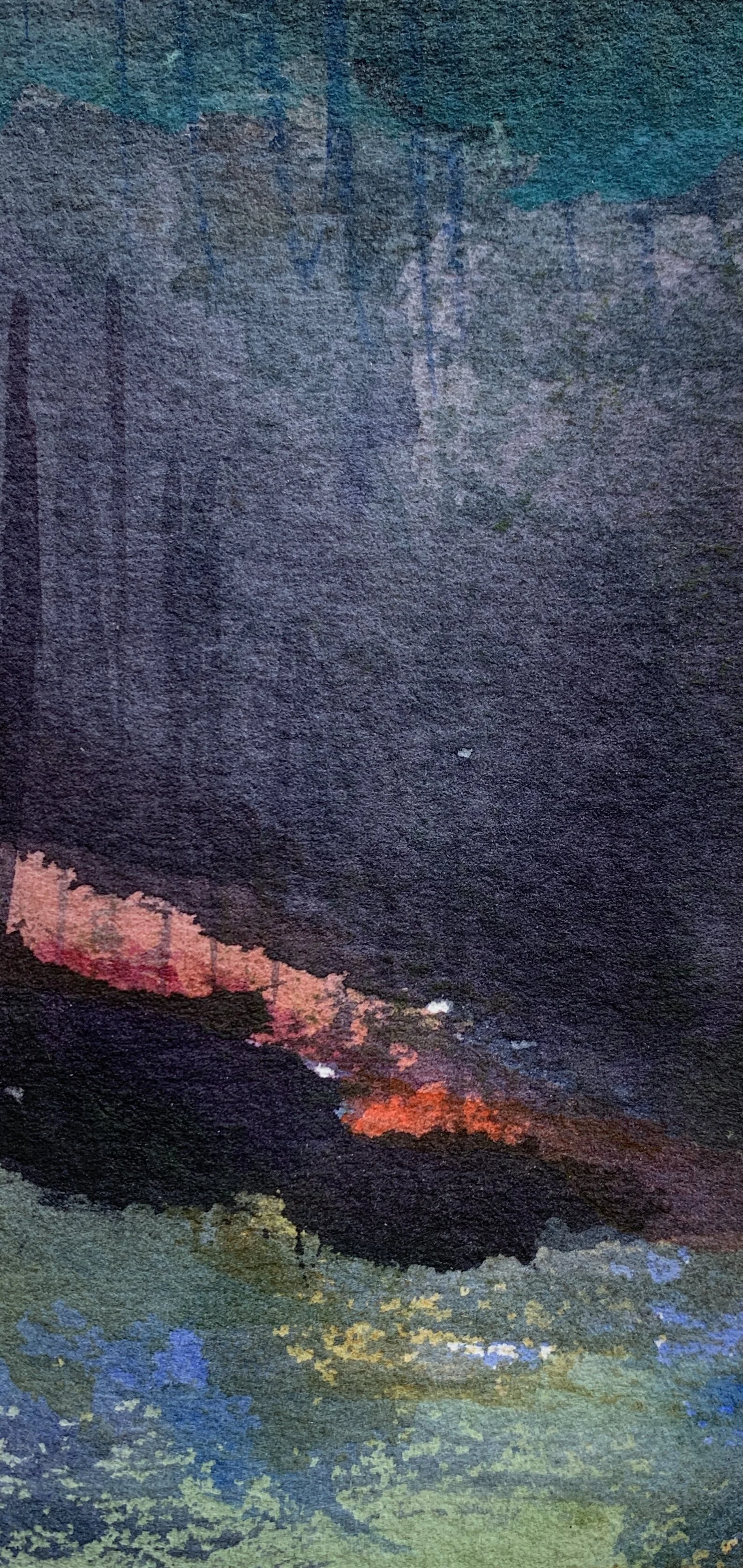
Rain, watercolor, LH
Yet another cold, rainy morning and I sit at my studio window watching tree swallows circle and loop, skim the water, and splash. They could be practicing touch-and-goes as if taking part in some aviation exhibition, but I prefer seeing them as painters dipping their brushes to color the pond and trees.
I first met swallows soon after I met Blase, my husband. We were sitting on the front step of the farmhouse and I asked, “If you were to be reincarnated as an animal, what would it be?”
Blase didn’t pause for very long before he said, “A swallow.”
“A swallow? Why?”
Blase has a deep voice that resonates in his broad chest. He played football during high school and college. He’s physical and strong, so I imagined he would say, a lion, or some impressive creature.
Blase answered my bewildered look, “Because they are so playful.”
I didn't know a swallow from a wren but took in his comment as something significant.
Then he turned to me and asked what animal I would choose.
I replied, “Maybe a lion.” I needed to be strong and able to fight for what I needed not only for myself but for my pride of three children.
I have completely come around to Blase’s point of view. For the swallows, regardless of the lack of warmth and sunshine, do their thing, eat insects, and dazzle us ground walkers. The secret of the swallows’ contentment seems to be their willingness to fly in any weather, to be a complete expression of joy no matter the circumstances. I know how hard that is to do, especially when strong emotions come up, especially when the suffering and grief I feel increases with every bit of news from around the globe.
Navigating the currents of difficulties that arise is our daily practice. The storms will never disappear, but we learn to be better fliers. Like the swallows, we practice our take-offs and landings, until one sunny day, involuntarily we grab a brush, paint the pond pink, the trees purple, and the sky an emerald green, even when it is raining.
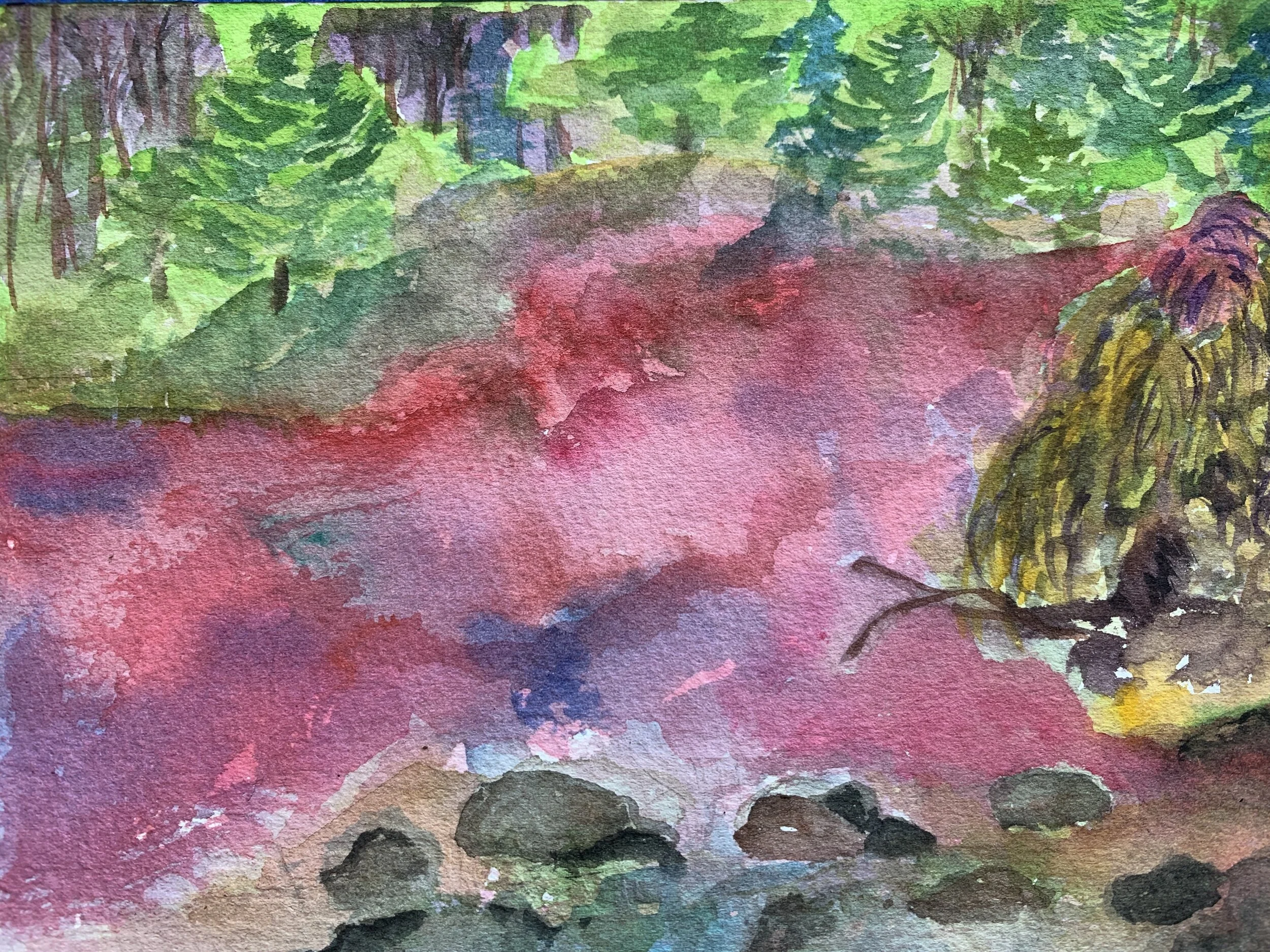
Pink Pond, watercolor, LH
Simple Pleasures
“I nurture simplicity among the gardens and fields”
—Chinese farmer and poet, T’ao Chien, 365-427 C.E.
These days, many of us have no choice but to bring simplicity into our lives. Many of our favorite activities have been taken away whether this means no gym workouts, no visiting with friends and family, or no shopping at a favorite store. We scrounge through the pantry shelves for something to cook, making do with what is on hand. Or go outside like I did the other night to gather parsley and a bit of coriander that overwintered, new shoots of spearmint, and a large bowl of stinging nettles, to add to some sad looking basil leaves in the back of the fridge. The greens, smushed into the Cuisinart, along with oil, garlic, lemon juice, and pecans made a hearty pesto. Our creative meals can bring us great delight.
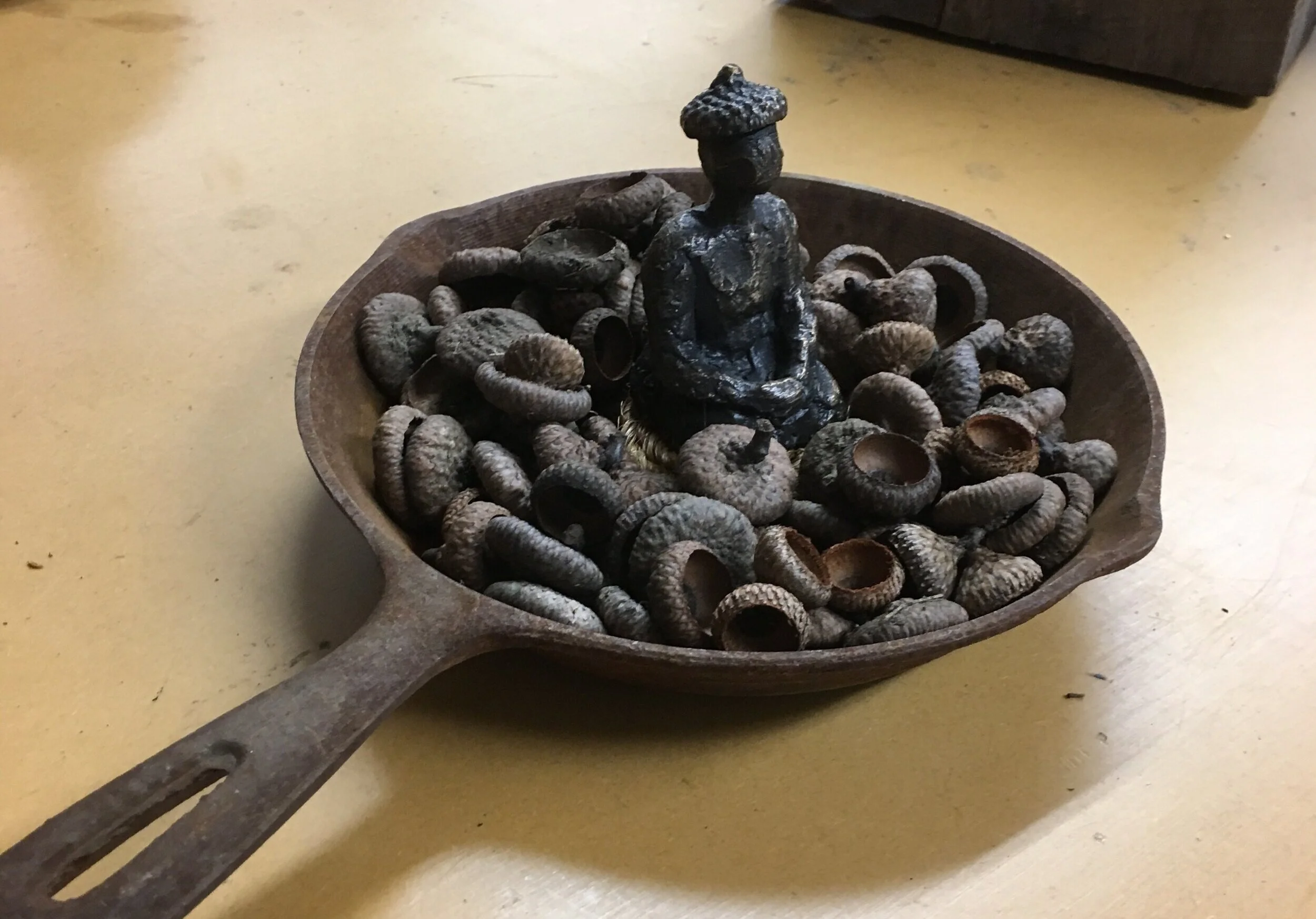
Simplicity can also mean living more intentionally, with more discipline and purpose. It can be unburdening our lives as well as decluttering our minds. Usually our minds flit from one thought to the next, from one sensation to another, moving quickly and erratically, but there is the silence when all distractions and desires fade. In many spiritual traditions, one sits in meditation to calm thoughts in order to experience deep silence. Sitting still, not moving, is the aid to find the stability of simplicity that allows for an opening to that great Silence.
For me, the concentration required by sculpting, painting, and writing creates the fertile ground for merging with the work, and within that merging, I find stillness. A musical score gives structure to mark periods of sounds and rests. The German-born pianist, Artur Schnabel (1882–1951) wrote,
“The notes I handle no better than many pianists. But the pauses between the notes—ah, that is where the art resides.”
The great jazz musician Miles Davis said it this way:
“Don’t play what’s there; play what’s not there.”
Lao Tzu, the Chinese sage advises, “Become empty of yourself and realize inner silence.” It sounds straightforward, but who knows how to empty themselves. I can’t sit myself down on a meditation cushion and say, I’m going to find silence: I only find myself in the midst of a great amount of activity. That’s why cultivating the earth always feels like cheating, the back door: the simple act of weeding as the antidote for the anxiety of our present times. But even weeding can be a challenge. I was talking to a friend yesterday and said,
“You know, weeding is not always that easy. It’s not just pulling the long white weed thread. Some weeds like vetch are impossible, impenetrable. It’s exhausting to dig through their density of roots. And when it’s that difficult, there’s no quieting the mind.”
Meister Eckhart, the Christian contemplative wrote,
“It’s not what we do that makes us holy, but we should make holy what we do.”
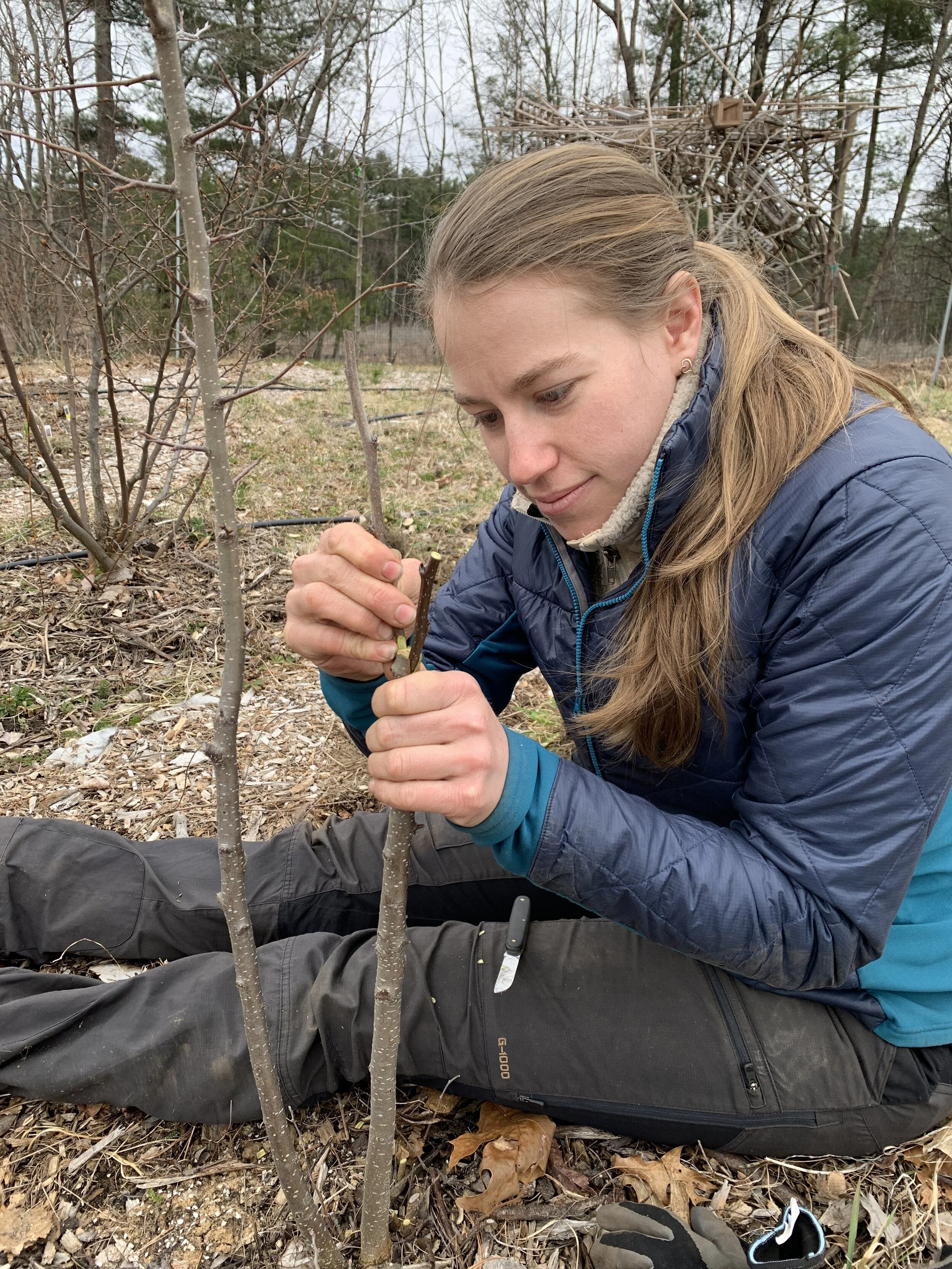
Ariel, grafting Olympic Asian pear scion wood onto rootstock in the Asian pear orchard.
So I return to the words of T’ao Chien: “I nurture simplicity among the gardens and fields.” I remind myself that he is surely weeding the gardens and plowing the fields, and he is nurturing simplicity. When I only concern myself with getting the work finished, checked off the to-do list, I take no pleasure in it. When I forget the to-do list, then the merging that I so love takes place. We can make holy everything we do. We can nurture simplicity everywhere.
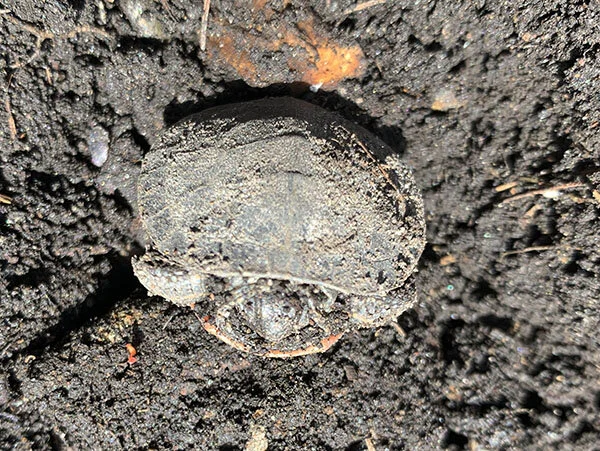
Baby snapper turtle Ariel found when we were moving a pear tree to plant new peaches. The turtle stretched and then we quickly dug it back into the soil.

Weeds and Other Gifts

A Small Piece of Land, Watercolor LH, 2020
“The greatest fine art of the future will be the making of a comfortable living from a small piece of land.” —Abraham Lincoln
When I am anxious or out of balance, which is often these days, I turn to weeding. I can always find weeds on the farm. The weeds are tenacious; they want to grow. One definition of a weed is a plant growing in the wrong place. We have lots of plants growing in the wrong places. Most of them need to be dug up. On the farm ‘to do’ list, weeding sits in almost every category: blueberries, raspberries, rhubarb, asparagus, around the apples, pears, and peach trees, the hoop house, and the kitchen garden.
Sitting on the ground, along the rows of blueberries, as if at a banquet table, each of us brings our favorite utensil. Ariel’s preference is the triangular Korean hoe, Holly prefers a claw, and I use a pink-handled small trowel.

Holly weeding young blueberry bushes on a cold and windy day.
We yank, we pull, we dig, leveraging our tools into thick mats of grasses, and tug some more. Grass clumps lift out—these get a hearty shake sending the worms and the soil attached to the roots back into the row, while whatever is left finds new life in the compost pile.

Frederic G. Cooper, 1917, U.S. Food Administration
My mind is occupied by thoughts of farms and food. The largest apple grower in our town depends on two migrant workers, but he has yet to hear from the embassy about their arrival. The commercial vegetable market in California doesn’t know how they will manage not only because of their dependence on migrant workers, but the chain of supply, the connective system, the trucks, the transport, the weigh stations, the middle places where all the packaging happens, are facing their own challenges. Farmers in Florida are plowing under vegetables, and in the Midwest, dairies are dumping fresh milk, though stores limit the amount customers can buy. Small farms feel the pressure, too. The restaurant that bought fifty pounds of greens a week is now closed, and many farmer’s markets have been canceled.
Abraham Lincoln promoted the cultivation of land after the bloodshed of the Civil War. During and at the end of World War II, the American Victory Garden movement created sustainability and health. England had their own movement, Dig for Victory. Maybe the restoration of the world’s psyche after times of great suffering was in part due to the return of our connection to the soil, to food. Maybe, it is a time to build more resiliency into our communities. Food is basic to our needs along with water, clean air, and shelter. We need to return to the basics and provide this for all people on the planet. Let’s give up fighting for causes and beliefs that only divide us. Let’s rally around what truly supports us.
I think about these things, and obviously oversimplify them, while I grab a small clump of grass, and ease out its long root system, pure white and thick, from among the blueberry’s dark, thin roots. Pull too hard and the root snaps. Only by teasing gently but firmly, can I coax out a foot-length root, with grass nodules every few inches, to release its hold. Of course, some weeds will quickly regrow, we don’t get them all, but if we don’t weed, the mass of growth under the blueberry plants will rob the bushes of nutrients. We weed in order to ease the competition for resources, to encourage a bountiful crop.
Weeding is not glamorous work and It doesn’t save lives, but it offers a connection to something trustworthy that helps keep me balanced. I know not everyone has access to weeds, but even in a city, we can break for a moment, see a bit of earth or touch a tree, and know this is all part of us. Amid slicing an apple, or washing salad greens, we can pause within our anxiety, and connect to this gift from the earth, the ground that sustains us.

This morning’s surprise: blown by the wind from a pile of old materials outside my studio.
.
Search Blog
-
2025
- May 9, 2025 A View from the Tractor Seat
- Apr 11, 2025 Dig
-
2024
- Jan 7, 2024 Winter Wassail
-
2022
- Dec 11, 2022 Keeping Time
- Jun 17, 2022 This Apple-Shaped Earth
- Jan 23, 2022 What is a Jizo?
- Jan 16, 2022 An Invite and Housekeeping Update
- Jan 1, 2022 The Year of the Frog: What Orchardists Do While Apple Trees are Chilling
-
2021
- Oct 24, 2021 Figs
- Oct 3, 2021 The Artist and the Orchard: A Memoir
- Aug 8, 2021 Red-Fleshed Apples
- Jul 25, 2021 When We Were Trees
- Jun 27, 2021 Castor Beans—Who Knew?
- Jun 13, 2021 Spring Training at a Zen Monastery
- May 4, 2021 Our Trees are in Bloom
- Apr 18, 2021 Hooray!
- Jan 24, 2021 Wassailing, virtually!
- Jan 1, 2021 Sitting
-
2020
- Dec 21, 2020 Darkness to Light
- Nov 28, 2020 One Heart
- Sep 18, 2020 Juggling Flowers, Fruit, and Vegetables
- Aug 23, 2020 Refuge
- Aug 9, 2020 Bags of Fertilizer
- Aug 2, 2020 The Sermon of the Blue Heron
- Jul 26, 2020 What's the Buzz?
- Jul 19, 2020 Farm Moments
- Jul 12, 2020 Lost Wax
- Jul 5, 2020 Catalpa: The Hugging Tree
- Jun 28, 2020 Pedaling Peace
- Jun 21, 2020 See Change
- Jun 14, 2020 Lalla Unveiled
- Jun 7, 2020 Pond Alchemy
- May 31, 2020 The Birth of Fruit
- May 24, 2020 An Artist in the Orchard
- May 17, 2020 Walking the Land: Returning Home
- May 10, 2020 Stinging Nettles: Gifts from the Great Mother
- May 3, 2020 The Mystery of Swallow
- Apr 26, 2020 Aerial Bruststrokes
- Apr 19, 2020 Simple Pleasures
- Apr 12, 2020 Weeds and Other Gifts
- Apr 5, 2020 Remembering the Seeds
- Mar 29, 2020 Blow on the Embers
- Mar 22, 2020 Ripples
-
2019
- Nov 16, 2019 Tibet Impressions
- Nov 9, 2019 Forest Tales
- Oct 13, 2019 The Gift
- Aug 4, 2019 The Season is Apples, Berries, and Grandfather Fire
- Jun 8, 2019 Pointers for a Writing Life
- May 12, 2019 Mothers of the Earth
- Apr 6, 2019 The Apple-Shaped Earth
- Mar 23, 2019 You Don’t Know What You Have Till It’s Gone
- Feb 23, 2019 Generations
- Feb 9, 2019 What Are We Doing to the Earth, John Chapman?
-
2018
- Dec 31, 2018 Long Shadows
- Oct 6, 2018 A Pilgrimage to India
- Aug 18, 2018 Scrap Wrenn
- Aug 11, 2018 Off-the-Wall Comments from an Ignorant Farmer
- Jul 28, 2018 Creative Connect
- Jul 14, 2018 How is the Orchard?
- Jun 30, 2018 Which Way?
- Jun 16, 2018 Geese, Herons, Beavers, and the Baby Steps of a Lapsed Blogger
- Feb 24, 2018 Mama's Coupons — Good Forever
- Jan 27, 2018 January Ice
- Jan 13, 2018 The Muse
-
2017
- Dec 30, 2017 A Dream for the New Year
- Dec 23, 2017 A New Year for Apples
- Dec 16, 2017 Intuition
- Nov 22, 2017 Thanksgiving OM
- Nov 4, 2017 East Fork Pottery
- Oct 28, 2017 Putting Down New Roots
- Oct 21, 2017 A is for Art
- Oct 14, 2017 Eve domesticus
- Oct 7, 2017 A String Workshop
- Sep 30, 2017 After Applepicking
- Sep 23, 2017 Two Bad Women and One Good Apple
- Sep 16, 2017 Plein Air Poetry
- Sep 9, 2017 Cutting Off a Leg
- Sep 2, 2017 The Changing Landscape
- Aug 26, 2017 All About Art
- Aug 19, 2017 My First Visit to the Farm
- Aug 12, 2017 The First Food
- Aug 5, 2017 A Teapot, a Woman, and maybe a Boat
- Jul 29, 2017 A Raspberry Dilemma
- Jul 22, 2017 Consider the Miracle
- Jul 15, 2017 Meeting Ekphrasis
- Jul 8, 2017 Ripening Fruit
- Jul 1, 2017 The Voice of The Caterpillar
- Jun 24, 2017 Goumi — An Unusual Fructus
- Jun 17, 2017 Concord, an American Bloomsbury
- Jun 10, 2017 The World Is Bonkers — Shall I Laugh or Cry?
- Jun 3, 2017 Bonkers, a Revolutionary Apple
- May 27, 2017 Guardians of the Swamp
- May 20, 2017 There are Mushrooms and There are Morels
- May 13, 2017 "What's in a Name?"
- May 6, 2017 Bloom Follows Pink: Orchard Pollination
- Apr 29, 2017 The Orchard Is at Pink
- Apr 22, 2017 Natural Farming — Part 2 (continuation from last Sunday's blog)
- Apr 15, 2017 Natural Farming — Part 1
- Apr 8, 2017 Boats, Figures, and Catching Fish
- Apr 1, 2017 A Man with a Mission: The Nuts and Bolts of Bronze Casting
- Mar 25, 2017 A Chalice of Spirit, Art, and Nature
- Mar 18, 2017 Hanami — Blossom Viewing
- Mar 11, 2017 Soil Redemption Song
- Mar 4, 2017 Food is Primary Care
- Feb 25, 2017 Pomme de Terre
- Feb 18, 2017 Organic Certification
- Feb 11, 2017 Tantalizing Fruit
- Feb 4, 2017 The Myths of History
- Jan 28, 2017 The Orchard in Winter
- Jan 21, 2017 The Hi-Line
- Jan 14, 2017 Artistic, Botanical, and Social Diversity
- Jan 7, 2017 Where is Eden?
-
2016
- Dec 31, 2016 The Creative Heart
- Dec 24, 2016 A Christmas Tale
- Dec 17, 2016 Who are the Crones?
- Dec 10, 2016 The Olympic Bell (Part Two)
- Dec 3, 2016 Overheard in the Apple Orchard in Early December
- Nov 26, 2016 The Lessons of a Tortoise
- Nov 19, 2016 In the Studio
- Nov 12, 2016 Even in Darkness
- Nov 5, 2016 Southern Apples, an Elephant, Monkey, Rabbit, and Bird, Two Mango Trees and a Birthday
- Oct 29, 2016 The Tools of Art
- Oct 22, 2016 Labyrinths
- Oct 15, 2016 Repairing the Broken
- Oct 8, 2016 When You Are No More
- Oct 1, 2016 Creation Rain
- Sep 24, 2016 Breaking the Glass
- Sep 17, 2016 String Art
- Sep 10, 2016 Poetry and Photosynthesis: It's all in the Leaves
- Sep 3, 2016 In the Plenty of Time
- Aug 27, 2016 Witch Doctors
- Aug 20, 2016 Listen Coyote
- Aug 13, 2016 Milkweed in the Orchard
- Aug 6, 2016 Some People See a Turtle
- Jul 30, 2016 Arborshaping
- Jul 23, 2016 Joseph Wheelwright: Sculptor of Stones and Trees
- Jul 16, 2016 Asian Pears
- Jul 9, 2016 Gold Leaf, Grief, and the Creative Process
- Jul 2, 2016 The Olympic Bell (Part One)
- Jun 25, 2016 Around the Mulberry Bush
- Jun 18, 2016 Avoiding Apples
- Jun 11, 2016 Fructus
- Jun 4, 2016 Astonishing Apples
- May 28, 2016 Scare the Caterpillars
- May 21, 2016 Join the Club!
- May 14, 2016 The Graft
- May 7, 2016 Rooster, Rhubarb, Rue
- Apr 30, 2016 What do Dolphins and Nettles Have in Common?
- Apr 23, 2016 Art Prunings
- Apr 16, 2016 A Few of the First Arrivals
- Apr 9, 2016 Taste the Spirit of Sustainable Agriculture
- Apr 2, 2016 First Orchard Spray - March 22-24, 2016
- Mar 26, 2016 Hawkeye Apple
- Mar 19, 2016 Desiring the Almata Apple
- Mar 12, 2016 Ugly Fruit
- Mar 5, 2016 Winter Tracks
- Feb 27, 2016 Splash
- Feb 20, 2016 Pruning
- Feb 13, 2016 Orchard Ruminants
- Feb 6, 2016 A Gathering of Seeds
- Jan 30, 2016 Orchard Dragons
- Jan 23, 2016 Tree Rings
- Jan 17, 2016 The Fallen Tree
- Jan 7, 2016 Wassailing the Apple Trees
- Jan 1, 2016 The New Year