LINDA HOFFMAN
Soil Redemption Song
Michael Phillips, author of The Apple Grower and The Holistic Orchard, now has a new book, Mycorrhizal Planet, just published by Chelsea Green Publishing. There was some disagreement between Phillips and the publisher about the title for the book, so he conducted a poll asking friends for input. A cattle rancher, a regional publisher, a permaculture guru, a biodynamic herbalist, an academic, and an orchardist/artist, among others, all weighed in on which of three titles they preferred. I voted without hesitation for Mycorrhizal Alchemy, but Chelsea Green decided to go with Mycorrhizal Planet (Mycorrhizal Pathways was the other choice). Alchemy suggests transformation, mystery, and ancient practices, all of which I am drawn towards. It’s a little like taking old found objects and making them into art.
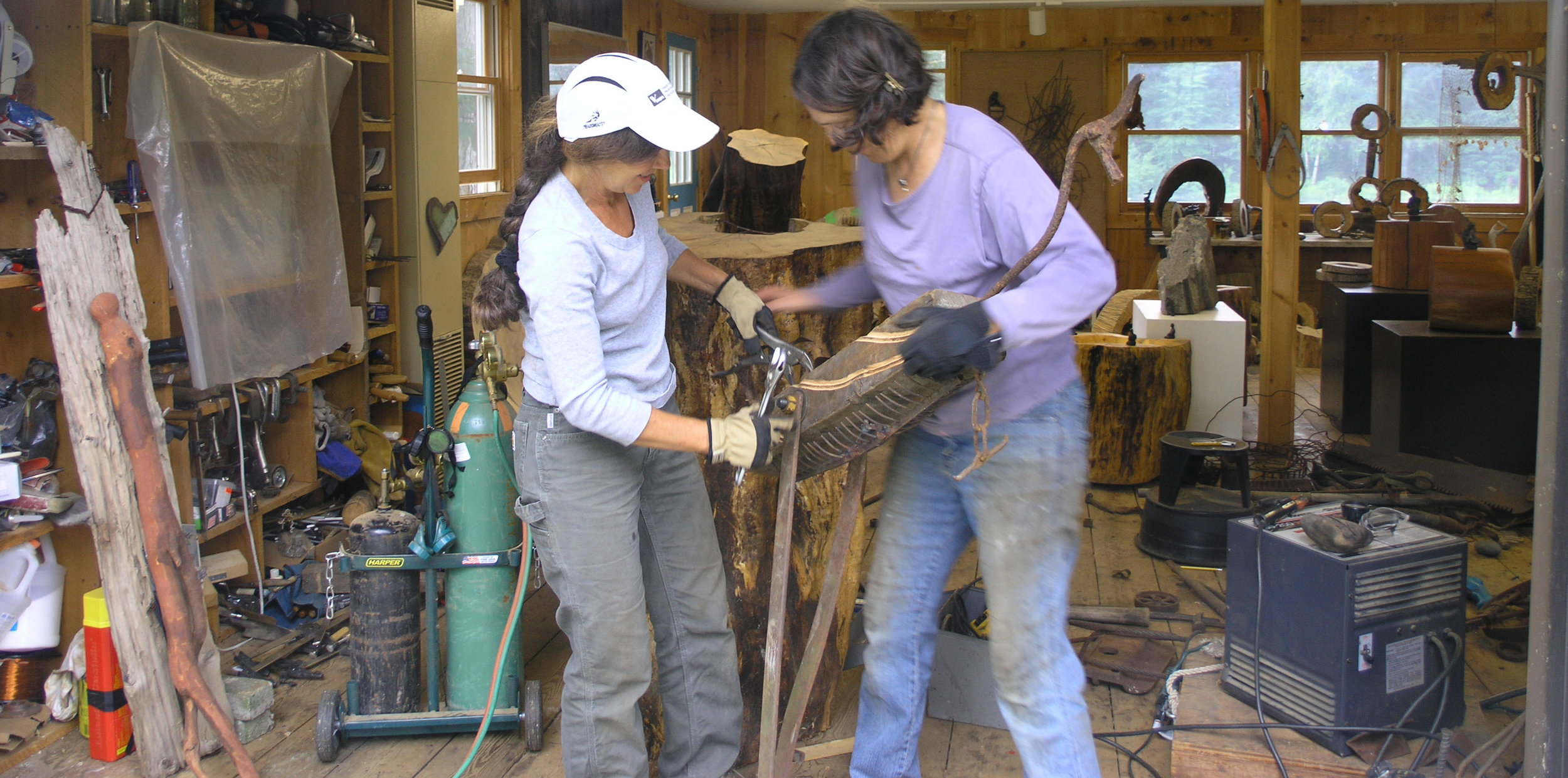
Linda Hoffman (left) and Madeleine Lord working on Belle the Bird in Hoffman's Studio, 2009
In the painting, The Alchemist by Cornelis Bega, a hunched figure sits in a cave-like room, intent on what is happening inside a glass jar. Books, notebooks, and earthenware pots surround him, suggesting a lifetime of mixing substances and studying their reactions. The alchemist is grounded and humble in Bega’s depiction. It’s a lonely art, much maligned as a materialistic quest to turn ore into gold; when, in fact, alchemists made considerable contributions to early science.
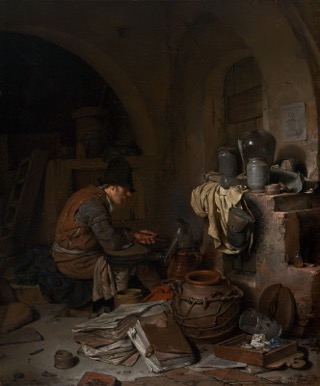
The Alchemist, Cornelis Bega
I think of Michael Phillips like this alchemist, studying the threads of life in the soil, appreciating them, and sharing their magic. Mycorrhizal fungi form a fibrous network stretching throughout the soil, attaching to roots, and connecting plant roots to each other. These fungi process minerals and feed them up to the plants, sending up just what is required. They will even provide storage for a plant’s bounty until leaner times, or pass on needed nutrients to other plants. It's a hidden world that scientists are only beginning to explore.

Photo courtesy of Larry Petersen, University of Guelph
“Each and every Mycorrhizal pulsating with nutrient flow, [is] making our lives possible,” Phillips writes. I consider Phillip’s passion to understand soil devotional.
Interestingly, Buddhism conceives of our world as one in which everything is interrelated and interdependent; nothing is separate in all of existence (or non-existence). Buddhism uses the analogy of the jeweled Net of Indra to describe this global interconnectedness. Imagine a vast net spreading out infinitely in all directions. At every crossing point in the net is a reflective jewel, and each jewel contains the reflection of every other jewel. If I were to put a mark on one gemstone, it would appear on every other one. How we treat one person ripples across the entire world.
The world under our feet is no different. Trees even share nutrients through Mycorrhizal fungi attached to their roots with trees of different species. It’s a little mind blowing — this network of fungi in the soil supporting the cosmic connection between all beings throughout space and time.
Phillips told me that he actually wanted the title to be Soil Redemption Song, inspired by Bob Marley’s haunting Redemption Song.
[…]
Won't you help to sing
These songs of freedom?
'Cause all I ever have
Redemption songs
Redemption songs
Emancipate yourselves from mental slavery
None but ourselves can free our minds
Have no fear for atomic energy
'Cause none of them can stop the time
How long shall they kill our prophets
While we stand aside and look? Ooh
Some say it's just a part of it
We've got to fulfill the Book
Won't you help to sing
These songs of freedom?
'Cause all I ever have
Redemption songs
Redemption songs
Redemption songs
Michael told me that as he pondered the lyrics of this song, he wrote, “Healthy plant metabolism begins with a molecule of water, a breath of carbon, and light energy from our nearest star. The tangible science behind all this unlocks the righteous way to farm and garden, give honor to trees, and plain do right by this earth. Nothing has ever excited me more.”
Mycorrhizal Planet provides practical information for the farmer, gardener, orchardist, and forester, as well as inspiration for all of us who have temporarily lost heart from following the daily news. If you’d like to order the book please go to Phillips’ website. He’ll sign a copy and send it to you.
Listen closely when you next walk among the trees. You might just hear the great alchemist Bob Marley singing — transforming our pain with his courage. Listen!
The Hi-Line
“One of the most calming and powerful actions you can do to intervene in a stormy world is to stand up and show your soul.”
—Clarissa Pinkola Estes, author of Women Who Run with the Wolves
It is Saturday morning as I write this blog in Kona on the Big Island of Hawaii. I am here with my partner, Blase, to visit my son, Nick who lives here. It feels like everyone else I know is either readying for walking in one of the Women’s Marches or despairing about the inauguration. Since arriving in Kona two days ago, the ocean swells have been several times normal. Driving along the rocky coast Nick can’t keep his eyes on the road as he is drawn to watch the surf breaking in high waves along beaches and inlets that are usually quiet. We stop often to watch and photograph.
As I write on a terrace where I can see the breaking waves and hear the chorus of forceful, soulful, singing; I hear the energy of Martin Luther King breaking into our collective longing with I Had a Dream. I think about what I can do in the upcoming days, and weeks, and months with this new world order. I think about what we can each do to shine our light, to fan the embers and make them glow.
On our first day we drove to the southernmost tip of the Big Island, the southernmost point of the United States. The trees grow horizontal, their branches pulled as if by some invisible force, an unceasing tug of war between the fierce thrust of the constant wind and the need for the tree to remain rooted. it felt like an apt metaphor for the position so many of us feel we are in today.
Yesterday we drove the opposite direction, to Popolu in the north, a rough, ragged beach with boulders and rough seas, that sits at the end of a valley between two great ridges.

Nick led us down the steep trail, knowing at the bottom some of his friends were already there. They had strung a hi-line between trees in the woods behind the beach. A hi-line is a slack rope, and theirs was set so that you had to walk over a ravine. We watched as one man, strapped with harness and clipped onto the line so he couldn't fall to the ground, began. Body erect, arms shifting side to side, torso adjusting with each minute waver of instability, countering, moving from instability to stability to instability, never a moment of settling into inactivity. He knew how to walk the distance, he’s been walking the hi-line for a while, but had always feared the line when there was a deep crevice to cross. It takes immense concentration to simply step up and balance on a slack rope. You never look down, you must breathe and relax, and fiercely keep your point of focus. I watched his intense physical and emotional single-minded attentiveness with awe. He had to quiet the uproar of fear or he would fall.
A young woman was up next. He reminded her, “We are here to challenge ourselves, to go where we most fear.”
What do I fear most? That is the question I will carry with me. At each moment what am I fearing? Because if I am fearing, then I am not loving. And there are only these two possibilities. There are infinite ways to carry the light. It is up to each of us to be uniquely ourselves and bare our souls. There are no shoulds, no instruction set for how to step forward; we are each on our own unique hi-line. But some of the same guidelines apply — concentrate, relax, give in, forget the self, and go for it. And perhaps most importantly, never forget to focus on what matters most to your own soul, because that will be the truth and that will kindle the flame for others.

Judith Taisei Schutzman at the Boston March
Who are the Crones?
We are the crones, the old and wrinkled, wise ones. We have many names— Hecate, Spider Grandmother, Demeter; Siren, Gaea, and Oracle. We wait at the crossroads. We praise and encourage the living, we honor and care for the dying. In times of darkness, we know spring will return.
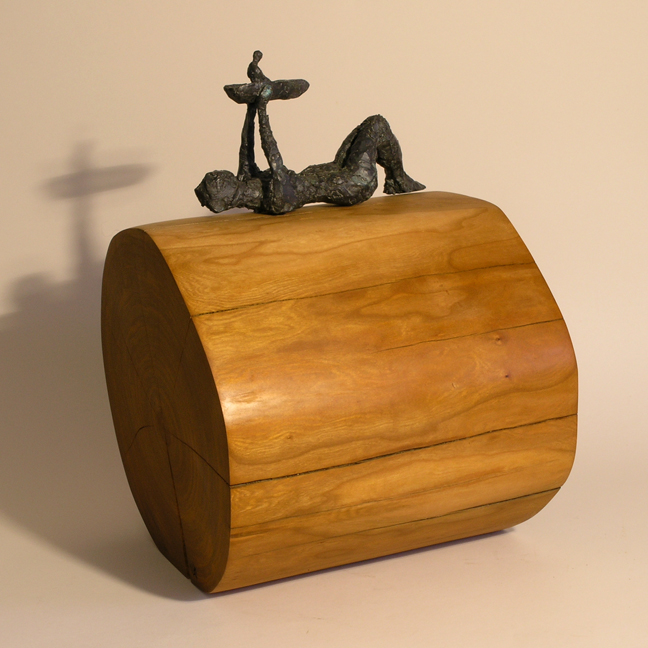
Woman Launching Boat, bronze sculpture, cherry wood, LH
At the time of the winter solstice ancient people believed that we must help the Light to be reborn. In many cultures, the crones facilitated this return. Women carried the mystery of life and death; women labored to guide back the sun.
Then things changed and men took control of women, especially in matters of religion.
Buddhism has traditionally followed the established social norms of the patriarchy into which the Buddha was born. When the Buddha established the rules for his followers, he differentiated between nuns and monks. Any nun, no matter how old or enlightened, had to bow down to a monk, even a novice. In Zen monasteries, the lineage of the transmission from one male teacher to the next has always been chanted as part of the service. Recently, things are changing. At Zen Mountain Monastery we now chant the names of the enlightened women of the way in addition to the male lineage. There were many great and compassionate teachers who taught students both male and female. Today, we have an altar in the front of the meditation hall for Mahapajapati, the first Buddhist nun and teacher.
I began to think about other groups of women left unsung. In the American frontier world, Johnny Appleseed is a celebrated hero. He stands out as a bold revolutionary, spreading seeds and saplings, helping the settlers establish ownership to land by planting an orchard, and sharing his beliefs based on the Swedenborg religion. But who are the frontier women who helped create this country? I found a few famous names—Belle Star, Poker Alice, Pearl deVere, Annie Oakley, Etta Place, and Calamity Jane. Belle was known for riding in a black velvet dress, six guns on her hips, and holding up stagecoaches. Poker Alice—you guessed it—was a devilishly good poker player, and bordello owner. Pearl deVere operated The Old Homestead, a lavishly upscale brothel in Cripple Creek, Colorado. You get the picture. Nice women don’t make history, but the names we choose to remember determine the history we remember.
The myths of ancient people are filled with stories of goddesses whose powers equaled that of their male counterparts. The history of women in the West is much more than brothels, bars, and Wild West shows. It is the story of hardworking American women, Native American women, Spanish-Mexican women, and the Chinese immigrant women who were sold and shipped to California by their impoverished families to work in laundries, bars, and mining camps. We need to remember all of these women and what a dark place the world has been for so many of them.
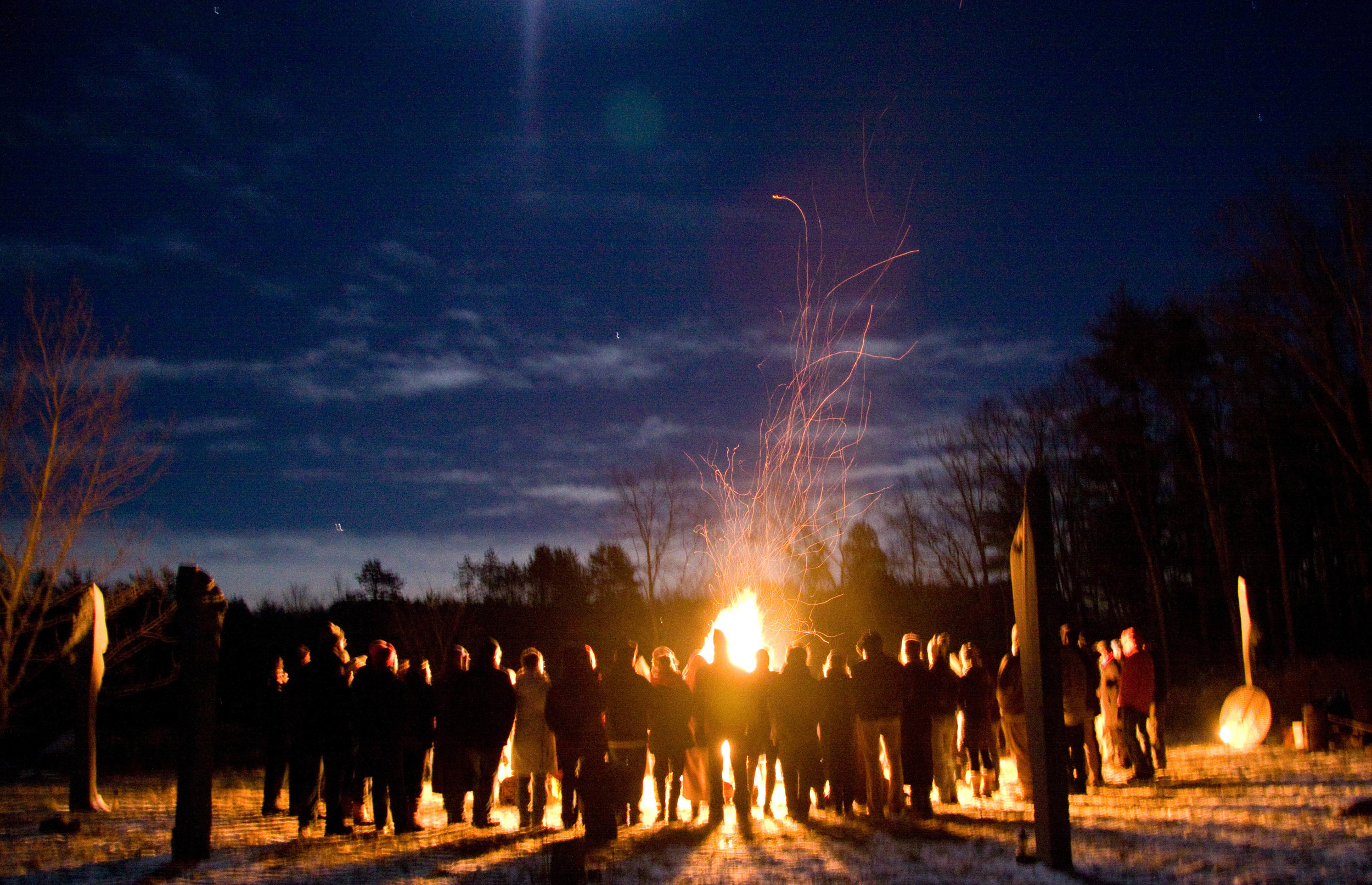
Solstice Fire, Old Frog Pond Farm, photo: Alexis Pappis
December 21st is the winter solstice, the darkest day of the year. At the farm we have a solstice fire where we reenact the return of the sun. In our ritual, it is the crones who go on a journey to find the sun and rebirth the Light. The crones remind us that there are many kinds of darkness. The darkness of racism and sexism, of hatred and war, of injustice, of sorrow and loss. The crones also remind us that there is darkness inside each of us, as well as a light. It is from this light, this often forgotten or darkened light, that the Goddesses labor, and birth the sun. Like Demeter knowing that she will be rejoined with her daughter, Persephone, we need to trust that the light will return, grief will be healed, and plants will bear fruit again.
Carl Jung said, "One does not become enlightened by imagining figures of light, but by making the darkness conscious." In remembering the names of those women who are forgotten, we shine light into the darkness of their cultural obscurity. As we light the solstice fire, we bring light to this world stamped with anger, aggression, and force. In gathering and opening our hearts to one another we grow the light. Happy Solstice!
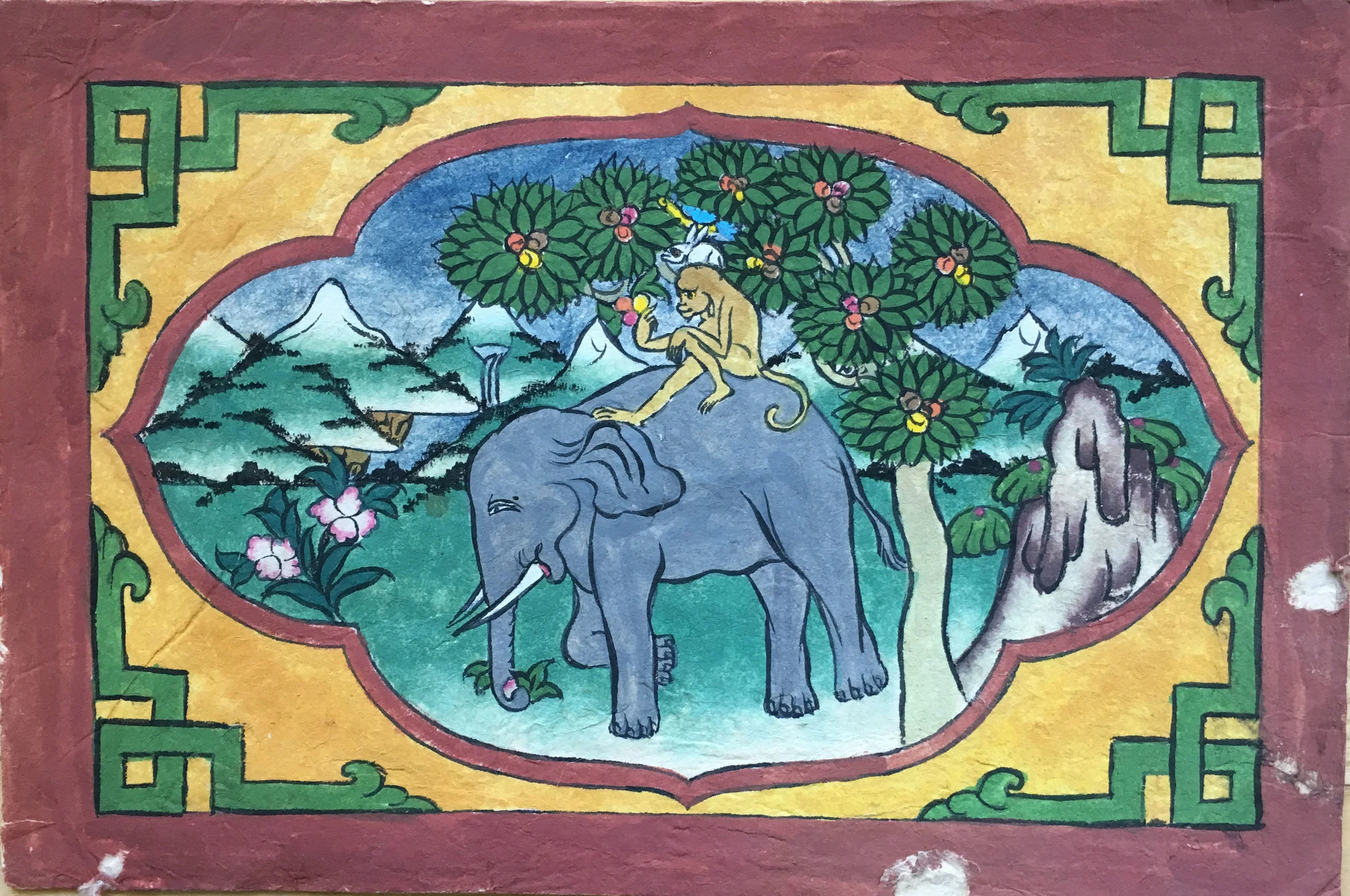
Southern Apples, an Elephant, Monkey, Rabbit, and Bird, Two Mango Trees and a Birthday
I celebrated my 60th birthday this week. My partner, Blase, gave me a first edition of the book Old Southern Apples, written by Lee Calhoun. Southern apples might sound like an oxymoron, since not many people think of the South as an Eden of apples. But over 1300 varieties originated south of the Mason-Dixon Line, and these apples are an important part of the area’s agrarian history. Old Southerners not only talk about Bloody Butcher corn and Red Ripper peas, but the now extinct apples like Fall Ambrosia (sounds so delicious), and the still available Limbertwigs.
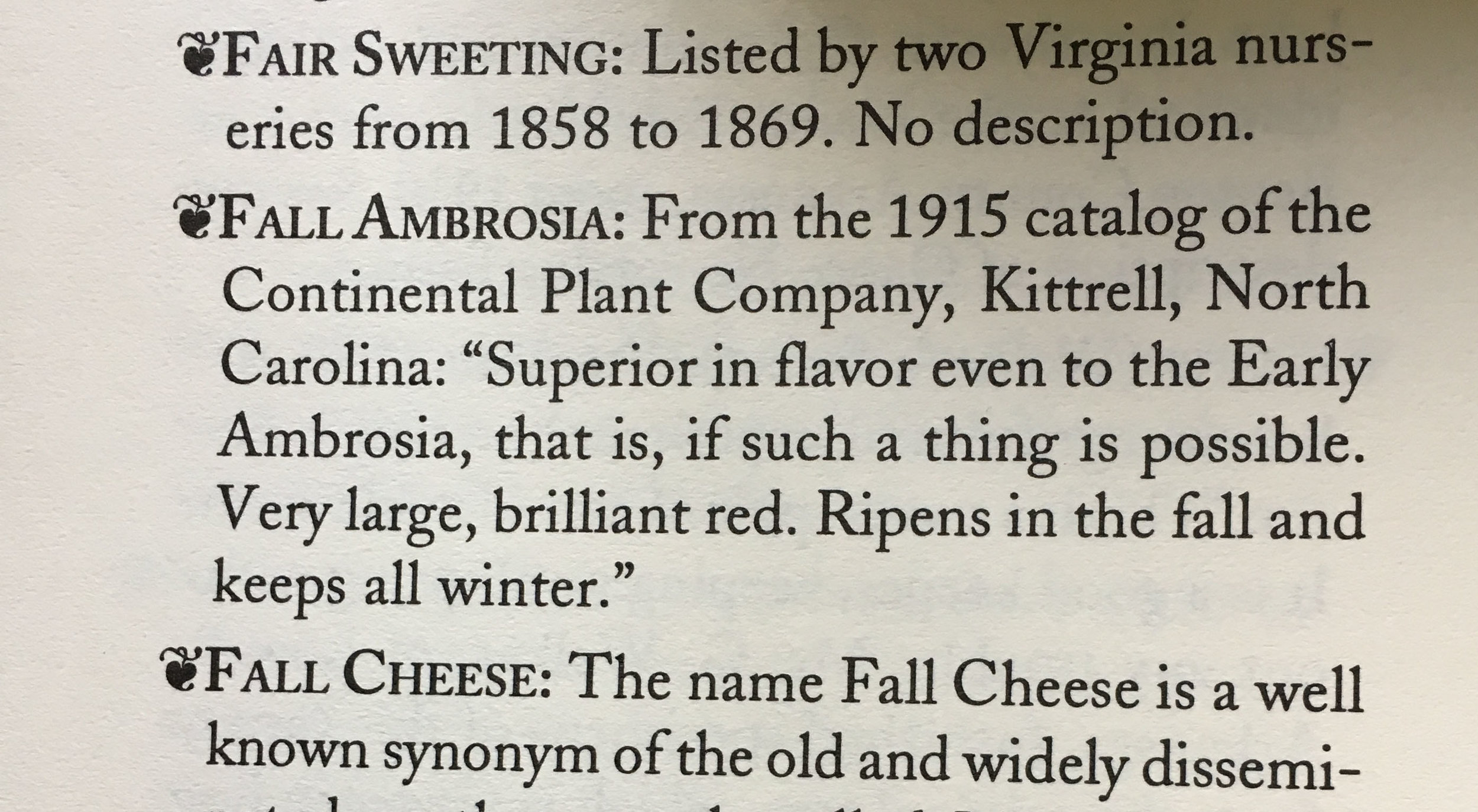
Old Southern Apples describes the unique features of over 1600 apple varieties (though 300 of them originated elsewhere but were grown in the South). The book divides these apples between 300 still growing or available at nurseries and 1300 now extinct Southern apples, the names and descriptions mostly taken from old nursery catalogues (a coincidence that both numbers are 300). The book also contains forty-eight plates of hand-painted apple pictures selected from the seven thousand in the collection of the National Agricultural Library. That was from the days when the United States Department of Agriculture hired artists!
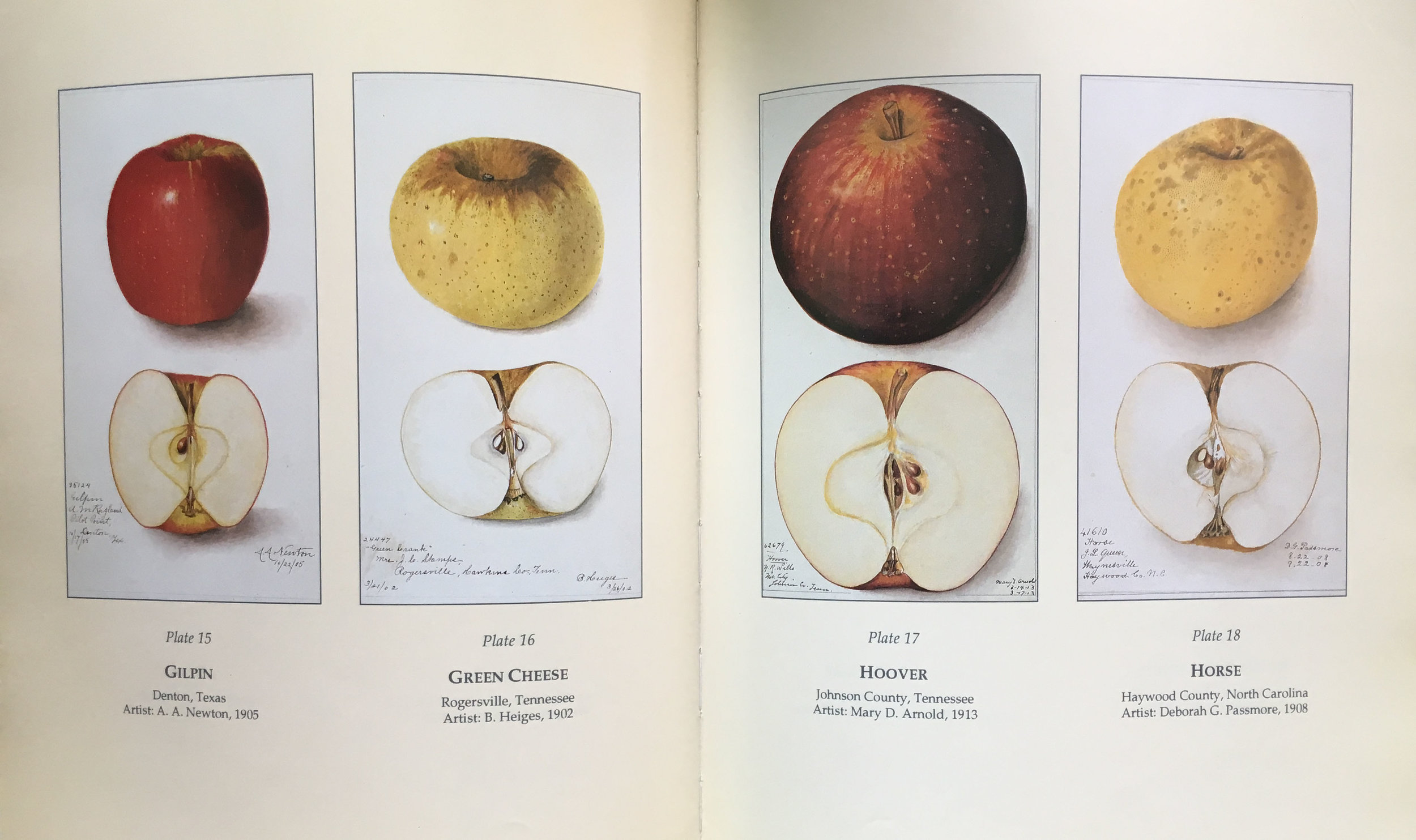
Old Southern Apples, Plates 15 - 18; Photos: Jerry Markatos
As you may know, apples grown from seed are the unique progeny of two parents, because the blossoms are cross pollinated. Most of these seeded trees crop with hard, sour, or small fruit, better for the hogs than for eating off the tree. Some apples are good for making hard cider and apple cider vinegar, but a few trees out of a thousand planted might produce unexpected, remarkable apples that would be given names and propagated. Of the 1600 apple varieties mentioned in this book, all of them grew from seed to be extraordinary apples. In the South, whether the settlers were large landowners or tenant farmers, they all planted out their orchards with seeds, they didn’t set out grafted rootstocks. It was the way it was done.
Today, it would be the rare individual who would scatter seeds to plant an orchard. After all, who would want a collection of wild apples? Large orchardists order sapling trees from wholesale nurseries in the thousands or even ten thousand. Blocks of the same variety, interspersed with another variety for pollinating, are planted. It is the researchers who cross apples and come up with new varieties for orchards to trial. A few apples become the darlings of the marketplace. This approach to apple growing is very different from the grand creativity that nature realizes with such ease. As Lao Tzu said, Nature does not hurry, yet everything is accomplished.
Inside my card, Blase tucked a print-out of a Buddhist tale. When King Mahajanaka, an earlier incarnation of the Buddha, was traveling through a park, he saw a monkey sitting on a branch of a mango tree. The King longed to stop and pick a few mangoes, but traveling with his large retinue, he had to continue without stopping. He decided he would sneak back alone that night to pick a few mangoes. That night, when he got to the grove, he lifted his torchlight and saw that someone had gotten there before him. The mango tree was stripped bare of fruit; its limbs were broken and its leaves lay scattered everywhere. He was saddened to think that this beautiful tree would likely not survive this ravagement. Then he saw another mango tree, one that had not been harmed. He realized that this tree avoided the carousing thieves because it had no fruit. The King returned and pondered his experience with the two mango trees. He decided he would renounce his title and give away everything he owned. He would become a tree without fruit. I love the story of the King Mahajanaka and the mango tree, but it could be taken as a teaching in renunciation. As many of you know, the orchard at Old Frog Pond Farm had no apples this year, and it was not because I renounced my title of orchardist.
The Birthday card Blase gave me was hand painted in Bhutan; he had saved it from our trip seven years ago. It is of a bird on a rabbit on a monkey’s shoulder, on an elephant (the bird and rabbit are hard to see). They are walking under a mango tree laden with fruit. It is an illustration of the “Four Harmonious Friends,” a much loved Bhutanese tale. These animals worked together; the bird planted the seed, the rabbit watered the sapling, the monkey fertilized it, and the elephant protected it until it grew into a beautiful tree with fruit for all of them.
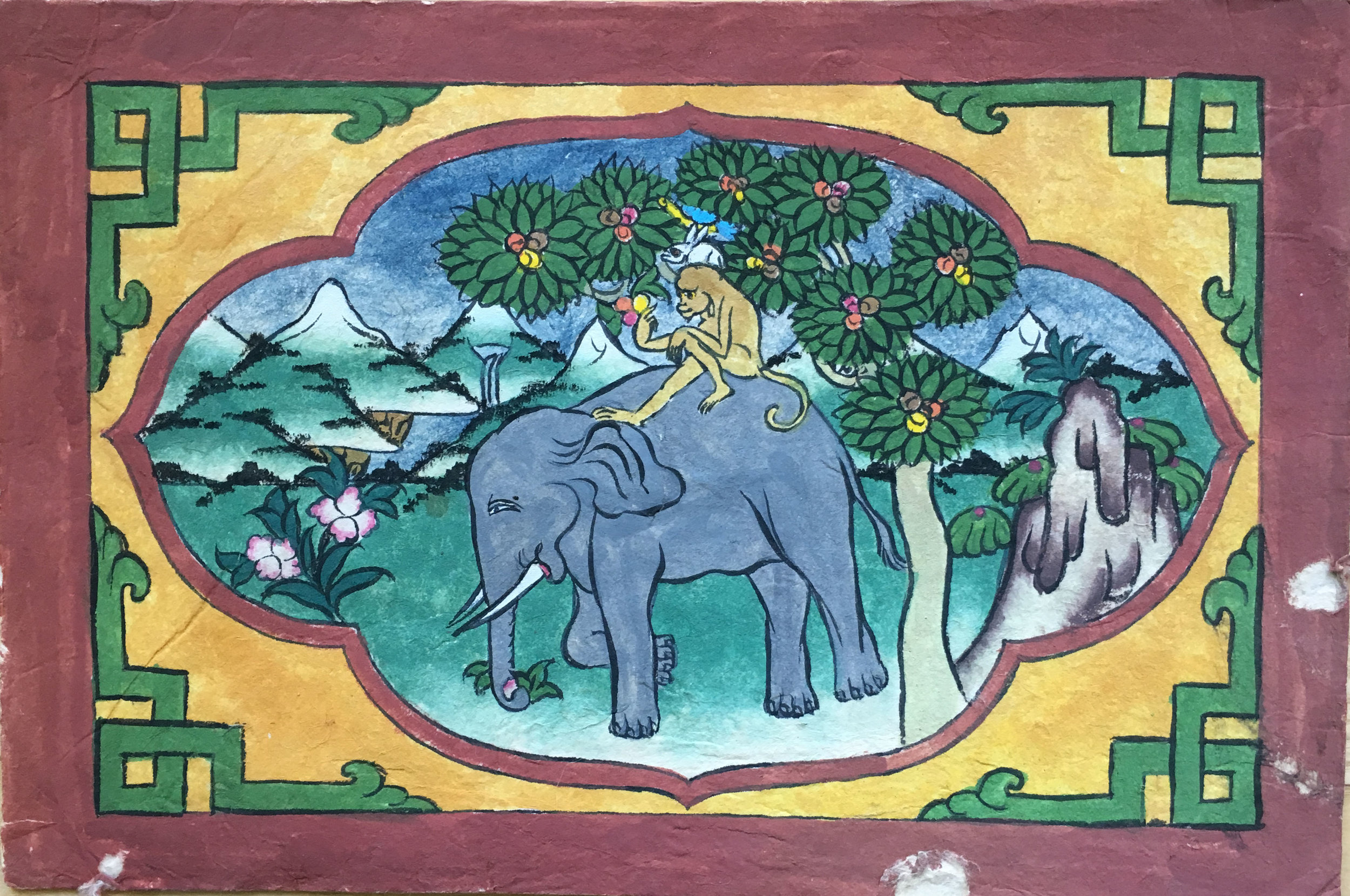
"Four Harmonious Friends" handpainted in Bhutan
I loved my gift of so many fruit related stories. Our orchard is so much more than its acres of grafted trees. It’s a language we speak and share; a wild grove of poetry, paintings, sunsets, clouds, blossoms, and, hopefully next year, delicious fruit.
Search Blog
-
2025
- May 9, 2025 A View from the Tractor Seat
- Apr 11, 2025 Dig
-
2024
- Jan 7, 2024 Winter Wassail
-
2022
- Dec 11, 2022 Keeping Time
- Jun 17, 2022 This Apple-Shaped Earth
- Jan 23, 2022 What is a Jizo?
- Jan 16, 2022 An Invite and Housekeeping Update
- Jan 1, 2022 The Year of the Frog: What Orchardists Do While Apple Trees are Chilling
-
2021
- Oct 24, 2021 Figs
- Oct 3, 2021 The Artist and the Orchard: A Memoir
- Aug 8, 2021 Red-Fleshed Apples
- Jul 25, 2021 When We Were Trees
- Jun 27, 2021 Castor Beans—Who Knew?
- Jun 13, 2021 Spring Training at a Zen Monastery
- May 4, 2021 Our Trees are in Bloom
- Apr 18, 2021 Hooray!
- Jan 24, 2021 Wassailing, virtually!
- Jan 1, 2021 Sitting
-
2020
- Dec 21, 2020 Darkness to Light
- Nov 28, 2020 One Heart
- Sep 18, 2020 Juggling Flowers, Fruit, and Vegetables
- Aug 23, 2020 Refuge
- Aug 9, 2020 Bags of Fertilizer
- Aug 2, 2020 The Sermon of the Blue Heron
- Jul 26, 2020 What's the Buzz?
- Jul 19, 2020 Farm Moments
- Jul 12, 2020 Lost Wax
- Jul 5, 2020 Catalpa: The Hugging Tree
- Jun 28, 2020 Pedaling Peace
- Jun 21, 2020 See Change
- Jun 14, 2020 Lalla Unveiled
- Jun 7, 2020 Pond Alchemy
- May 31, 2020 The Birth of Fruit
- May 24, 2020 An Artist in the Orchard
- May 17, 2020 Walking the Land: Returning Home
- May 10, 2020 Stinging Nettles: Gifts from the Great Mother
- May 3, 2020 The Mystery of Swallow
- Apr 26, 2020 Aerial Bruststrokes
- Apr 19, 2020 Simple Pleasures
- Apr 12, 2020 Weeds and Other Gifts
- Apr 5, 2020 Remembering the Seeds
- Mar 29, 2020 Blow on the Embers
- Mar 22, 2020 Ripples
-
2019
- Nov 16, 2019 Tibet Impressions
- Nov 9, 2019 Forest Tales
- Oct 13, 2019 The Gift
- Aug 4, 2019 The Season is Apples, Berries, and Grandfather Fire
- Jun 8, 2019 Pointers for a Writing Life
- May 12, 2019 Mothers of the Earth
- Apr 6, 2019 The Apple-Shaped Earth
- Mar 23, 2019 You Don’t Know What You Have Till It’s Gone
- Feb 23, 2019 Generations
- Feb 9, 2019 What Are We Doing to the Earth, John Chapman?
-
2018
- Dec 31, 2018 Long Shadows
- Oct 6, 2018 A Pilgrimage to India
- Aug 18, 2018 Scrap Wrenn
- Aug 11, 2018 Off-the-Wall Comments from an Ignorant Farmer
- Jul 28, 2018 Creative Connect
- Jul 14, 2018 How is the Orchard?
- Jun 30, 2018 Which Way?
- Jun 16, 2018 Geese, Herons, Beavers, and the Baby Steps of a Lapsed Blogger
- Feb 24, 2018 Mama's Coupons — Good Forever
- Jan 27, 2018 January Ice
- Jan 13, 2018 The Muse
-
2017
- Dec 30, 2017 A Dream for the New Year
- Dec 23, 2017 A New Year for Apples
- Dec 16, 2017 Intuition
- Nov 22, 2017 Thanksgiving OM
- Nov 4, 2017 East Fork Pottery
- Oct 28, 2017 Putting Down New Roots
- Oct 21, 2017 A is for Art
- Oct 14, 2017 Eve domesticus
- Oct 7, 2017 A String Workshop
- Sep 30, 2017 After Applepicking
- Sep 23, 2017 Two Bad Women and One Good Apple
- Sep 16, 2017 Plein Air Poetry
- Sep 9, 2017 Cutting Off a Leg
- Sep 2, 2017 The Changing Landscape
- Aug 26, 2017 All About Art
- Aug 19, 2017 My First Visit to the Farm
- Aug 12, 2017 The First Food
- Aug 5, 2017 A Teapot, a Woman, and maybe a Boat
- Jul 29, 2017 A Raspberry Dilemma
- Jul 22, 2017 Consider the Miracle
- Jul 15, 2017 Meeting Ekphrasis
- Jul 8, 2017 Ripening Fruit
- Jul 1, 2017 The Voice of The Caterpillar
- Jun 24, 2017 Goumi — An Unusual Fructus
- Jun 17, 2017 Concord, an American Bloomsbury
- Jun 10, 2017 The World Is Bonkers — Shall I Laugh or Cry?
- Jun 3, 2017 Bonkers, a Revolutionary Apple
- May 27, 2017 Guardians of the Swamp
- May 20, 2017 There are Mushrooms and There are Morels
- May 13, 2017 "What's in a Name?"
- May 6, 2017 Bloom Follows Pink: Orchard Pollination
- Apr 29, 2017 The Orchard Is at Pink
- Apr 22, 2017 Natural Farming — Part 2 (continuation from last Sunday's blog)
- Apr 15, 2017 Natural Farming — Part 1
- Apr 8, 2017 Boats, Figures, and Catching Fish
- Apr 1, 2017 A Man with a Mission: The Nuts and Bolts of Bronze Casting
- Mar 25, 2017 A Chalice of Spirit, Art, and Nature
- Mar 18, 2017 Hanami — Blossom Viewing
- Mar 11, 2017 Soil Redemption Song
- Mar 4, 2017 Food is Primary Care
- Feb 25, 2017 Pomme de Terre
- Feb 18, 2017 Organic Certification
- Feb 11, 2017 Tantalizing Fruit
- Feb 4, 2017 The Myths of History
- Jan 28, 2017 The Orchard in Winter
- Jan 21, 2017 The Hi-Line
- Jan 14, 2017 Artistic, Botanical, and Social Diversity
- Jan 7, 2017 Where is Eden?
-
2016
- Dec 31, 2016 The Creative Heart
- Dec 24, 2016 A Christmas Tale
- Dec 17, 2016 Who are the Crones?
- Dec 10, 2016 The Olympic Bell (Part Two)
- Dec 3, 2016 Overheard in the Apple Orchard in Early December
- Nov 26, 2016 The Lessons of a Tortoise
- Nov 19, 2016 In the Studio
- Nov 12, 2016 Even in Darkness
- Nov 5, 2016 Southern Apples, an Elephant, Monkey, Rabbit, and Bird, Two Mango Trees and a Birthday
- Oct 29, 2016 The Tools of Art
- Oct 22, 2016 Labyrinths
- Oct 15, 2016 Repairing the Broken
- Oct 8, 2016 When You Are No More
- Oct 1, 2016 Creation Rain
- Sep 24, 2016 Breaking the Glass
- Sep 17, 2016 String Art
- Sep 10, 2016 Poetry and Photosynthesis: It's all in the Leaves
- Sep 3, 2016 In the Plenty of Time
- Aug 27, 2016 Witch Doctors
- Aug 20, 2016 Listen Coyote
- Aug 13, 2016 Milkweed in the Orchard
- Aug 6, 2016 Some People See a Turtle
- Jul 30, 2016 Arborshaping
- Jul 23, 2016 Joseph Wheelwright: Sculptor of Stones and Trees
- Jul 16, 2016 Asian Pears
- Jul 9, 2016 Gold Leaf, Grief, and the Creative Process
- Jul 2, 2016 The Olympic Bell (Part One)
- Jun 25, 2016 Around the Mulberry Bush
- Jun 18, 2016 Avoiding Apples
- Jun 11, 2016 Fructus
- Jun 4, 2016 Astonishing Apples
- May 28, 2016 Scare the Caterpillars
- May 21, 2016 Join the Club!
- May 14, 2016 The Graft
- May 7, 2016 Rooster, Rhubarb, Rue
- Apr 30, 2016 What do Dolphins and Nettles Have in Common?
- Apr 23, 2016 Art Prunings
- Apr 16, 2016 A Few of the First Arrivals
- Apr 9, 2016 Taste the Spirit of Sustainable Agriculture
- Apr 2, 2016 First Orchard Spray - March 22-24, 2016
- Mar 26, 2016 Hawkeye Apple
- Mar 19, 2016 Desiring the Almata Apple
- Mar 12, 2016 Ugly Fruit
- Mar 5, 2016 Winter Tracks
- Feb 27, 2016 Splash
- Feb 20, 2016 Pruning
- Feb 13, 2016 Orchard Ruminants
- Feb 6, 2016 A Gathering of Seeds
- Jan 30, 2016 Orchard Dragons
- Jan 23, 2016 Tree Rings
- Jan 17, 2016 The Fallen Tree
- Jan 7, 2016 Wassailing the Apple Trees
- Jan 1, 2016 The New Year